Dealing with stress in children
Here are some suggestions on keeping your children’s stress levels at bay or at least contained in a manageable package. However, we recognise that stress factors operate around us all the time. Developing tactics to deal with them is the key.
Stress comes in all shapes and forms across childhood. Sometimes it is easy to move on from small matters other times it can be quite consuming for a child and very complex for a parent to manage. Either way stress in some form is part of all our lives.
Early man saw stress as a mechanism to survive. Once they recognised the degree of stress affecting their survival certain tactics were put in place to keep them alive. So we have been dealing with stress since the caveman era. It is almost part of our DNA.
Here are some suggestions on keeping stress levels at bay or at least contained in a manageable package. However, we recognise that stress factors operate around us all the time. Developing tactics to deal with them is the key.

Consider:
Getting enough sleep is so important for mental well-being. Check your child’s room. Is there adequate light reductions at night? Are they sleeping in a comfortable space that gives them several hours of uninterrupted sleep? Do they fall asleep quickly? What can you do to enrich their bedroom by inviting a better place for sleeping?
We often talk about physical exercise that will lower anxiety. The more children enjoy physical activities, the happier the space they are in. Consider all the sports that are on offer. Joining a team sport has immense befits for building personal stamina.
When a stress factor comes into play talk it through with your child. Maybe it can be worked through simply. The more the talk, the greater the propensity for solving the stress. Keeping silent about it only adds to stress and sometimes exacerbates the problem.
Fresh air and the outside environment is a wonderful distraction for stress. It is amazing how a walk through a park, a swim in a pool, a climb of a hill etc will take away the stress feeling. For children sometimes just a hit of the basketball in the yard is a great release.
Some children like to journal their feelings. If this is the case provide plenty of paper and a pencil or a diary to write about their feelings. Remember that you are encouraging them still to talk about the content so that you can both work on the stress factors.
Teachers will often encourage children to write about their feelings. It is recognised as a very legitimate way to express yourself.
Encourage your child to see their stress as something they can manage. Teach them that dealing with little matters can keep away the bigger anxieties. Set up a home environment that is open and invites children to talk about stress. By listening to them and not judging their worries they are more inclined to feel they can open up a conversation about anxious feelings.
A major source of stress can be school. Keep an open mind about school matters and ask your child open-ended questions like:
‘I wonder how school went today?’
‘School can be tricky at times. I remember when I had some issues to think about’.
Avoid using the dreaded basic question,
‘What happened at school today?’
Expect the answer:
‘Nothing.’
Keep an eye on the amount of stress that your child is displaying. For example monitor more carefully:
changed eating habits,
neglecting regular duties
heightened irritability.
increased defiance
letting go of friends
outbursts of irrational anger
When you think it is not manageable for a simple chat, time to take action and start with a conversation at school with the teacher. Much is revealed from such conversations.
Be astute and when you can avoid a stressful situation with your child avoid it. Less confrontation and reducing anxiety is the better option. To avoid stress is a proactive way of dealing with it.
Finally, we understand that we live in an environment that can trigger stress in our children. Our role as parents is to simply demonstrate the wisdom to be present and helpful with our children by effective listening. Be prepared, this sometimes means compromises on yourselves.
‘Courage is not the absence of fear but doing something in spite of fear.’
-Unknown

Respecting different values
We all cling to our values and beliefs. This is what makes us so definable. We are without realising it passing on many values to our children all the time. Here are some tips to help your child hold on to your and their values, and respect the values of others.
We all cling to our values and beliefs. This is what makes us so definable. We are without realising it passing on many values to our children all the time. It can be as simple as how you dress to whether tidiness is important in your family. Of course, there are more serious values such as racist viewpoints, and religious values. Political opinions etc can be a powerful statement of who you are and how you stand in the current world.
Little by little as you walk and talk with your child over the years your values are clearly laid out to them like a tapestry of life opinions. Every family has their own unique way of telling their story and passing on ideas and values to their children.

There is a challenge in this for us as parents. We may have strong values but are we open enough to talk to our children about the importance of respecting other values? They certainly will be exposed to this at school and as they mature they will begin to question and challenge even some of your most precious values.
The best way to ensure that your child understands your perspectives and is more likely to maintain valuing them is to be respectful of other's views and values.
Consider:
When your child talks about how other families value certain habits etc. be positive and say that everyone has opinions and chooses to make choices to live by. In my case, I prefer to live my way and this satisfies me.
If your child wants to talk about how other families do things differently, have an open conversation and listen to the opinions they are forming. Affirm their observation but gently state your values.
Discuss from time to time how values can differ and how having an open conversation about it is important.
Are you open to changing your values? Your child will grow and start to reflect on how they see their life forming. Sometimes this can challenge us to rethink our values and this can be a good thing. Here you show your child your open-mindedness and appetite to grow emotionally.
Talk about how in your friendship circle there may be people who share different values and yet you enjoy their company. Let your child know that you do not have a closed mind and you accept differences comfortably.
If you have values that you cherish, ensure that you consistently live by them as your child will respect you more when they see your consistency in living by your word. They will also look to see that such values actually make you happy.
The school you have chosen for your child will present their own set of values. Take care that you share them with your child so that they feel that they are in a safe and trusting environment valued by their parents. A child becomes confused when they see conflicting values between school and home.
Finally, your presence in the life of your child is a massive imprint on their mindset where your values are laid squarely in front of them to either adopt, modify or erase. As a parent show your tolerance and acceptance that values can vary and that people make choices that you may find unacceptable by your standards. By respecting their right to exist, your child will see you as a fair and reasonable person whose values just might be worth adopting for a lifetime, with some adaptation of course!
‘Open your arms to change, but don’t let go of your values.’
Dalai Lama

The art of bringing happiness to your child
A happy child is one that feels secure and has strong supports around them that intelligently allow the child to grow in an environment that is open, engaging and inclusive. As parents we try our best and the human side of us sometimes fails to hit the right mark. Here’s some tips to help bring happiness to your child - sometimes, in these stressful days, it’s important to help build a child’s level of happiness.
We are always seeking and wanting our children to have a happy life. It’s a natural instinct as a parent to embrace happiness for our children. Of course life comes in all forms and challenges will bring failures, distress, unhappiness and unwelcome surprises to a child’s life. Managing your way through that maze is part of the role of parenting. It also builds character and strengthens a child’s emotional reserve.
Here are a few thoughts that I have reached from my experiences with children that may help build a child's level of happiness.

Consider:
The first thought is that a happy parent makes for a happy child. Children will reflect your mood and sense of well being. Having the presence of a happy parent around is a strong indication to the child that the world is all well.
Keep encouraging persistence and effort. You are not rewarding perfection but you value the journey a child makes in their efforts to do well. Frequent affirmations around the efforts they make keeps the momentum going and shows the child that it is all about the ongoing contributions and not a perfect result.
By your own modelling teach them how to make friends. Show them how best you do this and what skills you need such as listening effectively, empathy, patience, humour etc. Your example will go a long way in teaching them how to build and sustain relationships.
See the optimistic approach to life. Find the positive in situations and when your child focuses on the negative, see the glass as half full. An optimistic approach attracts people and builds a strong happiness component.
We are working on building emotional intelligence in our children. This means that you should show them an intelligent approach to situations rather than using anxiety and reaction to deal with situations. Talk through with them their problems looking at a mature approach to solving matters. Of course how you personally demonstrate emotional responses to situations will teach your child, the best way possible.
Encourage self discipline. This can be done through insisting on finishing projects, completing jobs etc. Perhaps encourage children to wait for special treats rather than have everything instantly.
Be active as a family. Physical fitness and keeping engaged in activities such as sport give so much joy and feeling of self worth to growing children.
Allow failure into the life of your child. They need to learn that failure is part of life and we can learn form such experiences. This means not immediately trying to bail them out of trouble or solving their problems for them.
Slowly give your child progressive independence. Reward them with it when they demonstrate that they can be trusted. Feeling independent is a life giving experience and can be a significant growth curve for a child.
Keep play alive in your family. No matter what age everyone enjoys playing together. Find new and different ways of keeping play alive in your family.
A happy child is one that feels secure and has strong supports around them that intelligently allow the child to grow in an environment that is open, engaging and inclusive. As parents we try our best and the human side of us sometimes fails to hit the right mark. Good I say as after all we teach our children to be human.
‘Sometimes we forget that parenting like love, is a verb.’
- Jessica Joelle Alexander

A little bit of gratefulness goes along way
Everyone wants to feel appreciated. Showing gratitude also feels great. It is a power tool for building strong and trusting relationships. What a powerhouse of a gift to give to your child.
There are many words for it such as gratitude, thankfulness, appreciation and just thanks. Gratitude sometimes comes automatically, but it is a wonderful gift to give to your children. It can be taught and in this way, a child learns the value of using it.

Gratitude helps people feel more positive emotions, relish good experiences and generally it improves one’s health. It is a power tool for building strong and trusting relationships. What a powerhouse of a gift to give to your child.
Research tell us that grateful children tend to be much happier in themselves, more optimistic and have better social support from their peers. Grateful teenagers appear more at peace with their lives and are more engaged in school work, community and perform better at school.
The following thoughts help us think about how we can help our children develop the value of gratefulness.
Simply show a lot of gratitude in your own life. Be specific. Talk about things that make you grateful throughout the day. A child learns from hearing about your own happy experiences.
Point out when you notice others showing gratitude. It could be someone in the family or a friend etc. The more examples, the better.
Talk about famous people valued for their humble and grateful way of living. Why do people value them?
Acts of gratitude can be used to make amends, apologise and help solve problems. Demonstrate some time in your life that through being grateful the situation simply improved.
A wonderful activity in class is to ask children each day to write down three things for which they are grateful. This could be a fun activity to do at home. Some children may enjoy writing in a grateful journal.
Get into the habit of using simple thank yous and pleasantries as often as possible in the presence of your child.
Don't do everything for them. They will appreciate things more if they have jobs and responsibilities. If you take them away from your child there is a selfishness that will creep in to a child’s personality.
Being grateful reduces stress and improves self esteem. When you feel better by demonstrating gratefulness, talk to your child about how good it makes you feel.
Consider doing good will projects with your child. This is an excellent way to do something positive and helpful with your child. It is also a chance to talk about how this gives you pleasure to help others. Good modelling always runs off!
Think about various ways you as a family can be generous. How about donating toys, clothes etc. All this demonstrates how thinking of others is an important value in your family.
Consider sending thank you notes and asking your child to join in. This can be a special time talking about the words to use and why such words are important.
Finally, developing gratitude in children will take time. Your modelling and finding opportunities where your child can demonstrate gratitude will reap benefits in the longer term. Your child will grow, see and feel the advantages in being a grateful person as their years progress.
‘The deepest craving of human nature is the need to be appreciated.’
-William James

Finding ways to help a child’s anxiety
Children can feel anxiety, just as adults do. Anxiety is the feeling where we worry, we feel anxious and we can have a sense of dread. Here are some tips to help your child work through anxiety.
Anxiety is the feeling where we worry, we feel anxious and we can have a sense of dread. It can come in different forms and with different intensities. Children can have it in different forms and we can expect to see it from time to time in children as they go through various challenging stages in their life.
Here are a few ideas to help cope with the anxiety that can interfere with normal life and limit a child's ability to get on with their day to day experiences. If left for too long it can become quite serious.

Be prepared. Understand that every child will have anxious moments and you are there ready to listen and understand that for the child it needs to be respected and treated sensitively.
Keep active. A child that is busy with sport, outside activities after school enjoys games etc. can easily be distracted and taken away from those anxious moments. Also a child can learn that spontaneously taking on some activity can easily reduce bouts of stress.
Listen with intent. When a child feels anxious try not to question them. ‘Why are you sad?’ Put it another way.
‘Something has upset you. I wonder what that is?’
Probing the child to find out what is upsetting them may cause them to shut down and you are left with silence. No one enjoys probing questions when feeling poorly emotionally.
Allow space. Sometimes when a child is upset or has developed anxiety about something try to give them space and not over-talk or over-direct them. To some degree it is important that they have time to process their worries and to work through some solutions for themselves. Silence can be a useful tool.
Don’t be surprised that your child does not hear you when they are experiencing some anxiety. I found quite often that children who experience some shock or sudden anxiety block out everything around them as a way of coping for a while. If this happens allow your child some time before you set any expectations on them such as having a conversation.
Teach your child the art of deep breathing. Practise it together. This is a great way of learning about relaxation. Also, there are some beautiful relaxation tapes. Ask your child to choose one that they can listen to at night to help them sleep.
Children also love their own contemporary music. They can destress listening to their kind of music. Allow their music around the house and not just restrict it to their room.
For younger children drawing, singing, dancing and painting are all enjoyable distractions from worrying about problems. Is your home inviting to all these activities?
Encourage your child to talk about their anxieties. Make it part of your family culture where anxiety is discussed openly. It is best out and boldly in the open. If a child feels comfortable in talking about their anxieties and they are being acknowledged, they have somewhere to go with them. As a model, you too can talk about your anxieties and how you deal with them. In this way we make anxieties just a normal part of our family experiences.
Once your child talks about some anxiety discuss with them about setting small goals working towards real change. For example, if your child is anxious about talking in front of the class, your first goal could be for them to talk in front of the family.
Teach your child positive self-talk. When they talk about an anxious situation talk up how you can make it positive.
‘I know I can do it.’ ‘I can swim the length of the pool.’ ‘I will do it.’
Affirmation is especially important when they overcome some anxiety:
‘I am so impressed that you went in that competition. Bravo.’
Children who suffer from anxiety need the stability of routine and discipline to give them security. Also having family meals together and providing plenty of happy family times makes them feel safe and secure.
There is nothing more off putting for anxiety than laughter, joy and a sense of connection to others.
Finally, try hard to manage your own anxiety and be open with your child telling them how you managed it and what tools you used to overcome your anxiety. Make anxiety a normal part of getting on with life.
Don’t underestimate the value of doing nothing, of just going along, listening to all things you can’t hear and not bothering.’
-Winnie the Pooh

Let’s talk about some advantages of boredom
If we use boredom as a wind-down time, a time for just letting thoughts fly around, we will be surprised at the creative thinking that goes on in our head. We can reflect on matters that perhaps we have not thought of for a while. It's our role as parents to help our children see the benefits of boredom.
We have always been encouraged to chase boredom away as it is a sign of inactivity and sometimes can be linked to developing laziness.
Let’s start thinking that sometimes boredom can be a necessary and useful part of our life and well-being. It is an emotion that research is now saying is necessary in some way for our health.
With children, we fear inactivity and believe that boredom will make them disengaged from the real world. Therefore, it is common practice as parents to fill their days with busy activities and to keep their minds active with sports, hobbies, etc. There is something we now know for simply sitting alone with your thoughts and feelings. The question that modern studies are posing:

‘Is there a problem with nothing happening as opposed to having things happen all the time?’
Teachers know well that when there is an overload of activities, work demands etc., in the classroom just having some time to sit and do what you like or not is important for balance. In such a free space, children can or may choose not to do anything. They are allowed well being space which is interpreted by them to suit themselves. No judgement is placed on how they use that time.
Consider giving your child some down time that is all their own and allow them the mental freedom to simply be. Set no expectations other than it’s a time to unwind without technology television etc.
Turn off the television one night and just let your child entertain themselves before bed. Being locked in their own thoughts is not a bad thing. It gives them time to simply think.
Consider watching the grass grow with your children. Nature walks are great for this. Feel the sensations of wind and heat on your face and talk about the sights and sounds around you. Simply being silent in such a space also has its advantages. Let the silence in and feel the difference.
Sometimes just a wander around the shops with your child merely looking and being curious, letting your imagination roll on is valuable idle time.
We know that walking has such physical benefits but it also has mental benefits. Encourage your child to enjoy walks. Also riding their bikes, skating etc are great times for wandering thoughts.
Listening to music is an easy one for a child. Encourage them to listen to their music sometimes with headsets and sometimes just as background music. Idle thoughts and concepts sometimes cross your mind in listening to music.
Doodling is another idle activity but one where thoughts wander and the brain is not having heavy expectations placed on it. Children love to doodle and to think simple thoughts with no expectations placed on them. This can be such a creative time.
Art activities such as play dough, sandpits, baking etc. are all times where a child can simply be without expectations placed on them. From such idleness comes new thoughts and dreams.
When your child says that they are bored use some of these occasions to suggest just having a quiet time with no real plan for a little while. Encourage a little of this from time to time.
If we use boredom as a wind down time, a time for just letting thoughts fly around, we will be surprised at the creative thinking that goes on in our head. We can reflect on matters that perhaps we have not thought of for a while.
Be a little like Einstein loaf around in your head and see what grows from that.
‘If you want freedom you have to come to terms with being okay in the now doing nothing.’
- Doug Duncan

How to get the best from your child’s teacher
It makes sense that as a parent you feel confident and that you are in a solid relationship with your child’s teacher. It is important to your teacher, and child also. There are many factors that go into running a school and teaching. Parents are naturally emotional when it comes to their children, so if you have any concerns, you’ll have a better chance of being heard when you are calm and responsibly talk about concerns with your child’s teacher.
We all know that building a strong relationship with your child’s teacher is the best way to support your child across a long school year. The teacher has five hours a day across forty weeks with your child and this is such a critical time in their development, physically, socially, emotionally and intellectually. It, therefore, makes sense that as a parent you feel confident and that you are in a solid relationship with your child’s teacher.

Here are some important messages that will help build and ensure you maintain that relationship:
Consider:
Firstly, the teacher needs to feel that they are respected for their work. In today’s world of high order criticism, teachers are easy targets and yet their work and contribution to the life of children is vitally important.
Let your teacher know that you respect the pressure they are under as teachers are accountable to higher authorities, policy documents, etc. Sometimes decisions made are out of their hands can be confusing and misleading for some parents.
Take care that when you are unsettled about some matter concerning your child at school do not talk about it unfavourably in front of the child. Talk to your teacher first. Children can get very confused when they hear parents being critical of their teacher with whom they build so much trust and respect.
Keep an eye out for notes, emails etc that come from the school. The better you are informed, the happier your child is that you are valuing their school life. Schools are big informers so keep an eye out for regular correspondence.
From time to time your child’s teacher may call you up to discuss disciplinary action for your child. Listen carefully to what they have to say and do not react in a way that down plays the teacher’s action. Have a mature discussion about the matter and try to support the teacher’s actions. This is certainly a way of showing respect for them.
Family situations keep changing. Make sure that you keep the teacher abreast of any new information that may affect the child’s school. Teachers are quick to pick up an emotional change in the child. Sometimes they may approach you with concerns.
When you do have an issue always show respect for the teacher and talk to them first. Going to the Principal first only complicates the matter as the principal will talk to the teacher and generally refer the issue back to them.
If you are unhappy with school policies, rules and regulations remember that these have not come from your teacher. They come from Parent Bodies, Education Department rules and the whole school staff. Best to talk to the Principal when concerned rather than thrashing out the issue with the teacher. Their role is specifically the teaching and care of your child.
Take care not to write long winded emails to your teacher. Often what you need to say can be said simply or spoken to the teacher. Emails should be written with care and not used as a vehicle to be offensive. This may sound harsh but sadly I have seen many such emails which have only led to deterioration of relationship with teacher and school. Parents have a better chance of being heard when they are calm and responsibly talk about their concerns. This is also an important example to give our children.
Finally, there is so much enjoyment for a parent to be happily engaged with the school. Also your child feels more content when they see how interested and involved you are in their school life. In my experience, parental support is a driving force for all the staff and school community. Everyone benefits.
‘Schools are great places for all the family’
-Gail Smith

How useful are questions when talking to children?
Do you ever get frustrated when asking questions to your child? Do you get the yes, no answers? If you are seeking information from your child, consider the question you ask. Here are some tips to get some communication started with your child.
Do you ever get frustrated when asking questions to your child? Do you get the yes, no answers which give you little information but they certainly make it an easy reply for the child?
If you are seeking information from your child, consider the question you ask. There are two types of questions. One is the closed question. This leads to receiving a specific answer. The answer will be very short. Often a yes, no, maybe. A closed question is phrased such as:
‘Would you like some lunch?’

‘Is school on today?’
‘Are you upset?’
Notice that one-word answers don’t give you much information but of course serve a purpose. Some children wait for more questions but others are satisfied that at least they answered. This can be frustrating for a parent who is seeking more information.
Open questions on the other hand give a child plenty of scope in how they answer them. They are a chance to talk more about feelings and attitudes regarding different matters.
Consider the open question:
‘Tell me about school today?’
‘How do you feel about having lunch early?’
‘Can you tell me about the maths test you had today?’
‘What is it like having a new teacher?’
These questions give a child plenty of scope in answering you and they offer more of an understanding of the situation. They are rich in information. They are a chance to have a real conversation and to understand much quicker if there are underlying problems.
With open-ended questions take care to:
Use them carefully. A child may give you a lot of information and you need to respect the information and not attack the generous answer.
Often an open-ended question may lead into other open-ended questions. This requires good reflective listening on the part of the adult.
Try to avoid following on with ‘why’ questions. They are clumsy and often shut down a child from talking.
Try not to use open-ended questions to simply satisfy your curiosity. They do invite a child to talk more and we need to respect what they have to say.
Remember that open-ended questions will continue to be useful if not used all the time. Sometimes a simple closed question gives you all the information you may need.
Be prepared that a child may disclose more of their emotions in answering an open-ended question and this will mean that you need to be prepared to pick up on this.
If you are not in a good position to listen to the answer of an open needed question wait until you have more time to focus on the child.
Finally, asking questions should not become a game especially when you become more skilful in using open-ended questions. Teachers often reflect on the mood and temper of a child before asking questions as they know the best response will come when the child is ready to talk. As parents, we work with our children on the run. This can sometimes cause us to stumble when talking to our children. Probing questions are often used when in a hurry for information. They are the least effective. Choose your times wisely when wanting to ask questions. This is more satisfying for both you and the child.
‘I don’t pretend we have all the answers. But the questions are worth thinking about.’
- Arthur Clarke

Accepting limitations and strengths for a child
A very young child at an egocentric stage, struggles with understanding that others can be better. With development and more self-awareness, they begin to start accepting themselves for who they are and recognising the bigger world around them. Read here for some different ways parents can help children to develop this awareness.
We often talk about the importance of focussing on a child’s strengths. Some call these gifts, others refer to them as potentialities.

In encouraging and supporting a child’s strengths it is also valid to help them understand that we all have limitations and sometimes there will be others who perform much better than ourselves. This can be quite an awakening for some children. Teachers work skilfully in classes to highlight children’s strengths and also to learn about understanding their limitations.
A very young child at an egocentric stage, struggle with understanding that others can be better. With development and more self-awareness, they begin to start accepting themselves for who they are and recognising the bigger world around them.
Consider:
Praise your child when they show strengths. In the same way affirm other children when you notice that they are performing well. Children need to understand that others can do well and outperform them. It is important to publicly acknowledge their strengths.
Be specific when you affirm them. Tell them exactly why you admire some strength that they show.
‘I am so impressed in the way you play as a team member. You share the ball and act as great support for all the members of the team.’
When you talk to your child about limitations it is done in such a way that improvement is possible but we cannot be good at everything.
‘I can see how hard you try when you skip with your rope. Practice helps to make things better. Good luck.’
Here you acknowledge the effort but don’t put unrealistic expectations on them when you can see that they are struggling.
As a family talk about some of the great sports people, scientists etc. that have worked hard and succeeded and sometimes talked about their own limitations.
As the child grows to feel stronger and more in control of themselves, it is good if they can congratulate others who show greater aptitude than themselves in certain areas. This is called developing an emotional maturity.
With several siblings in the family there can be naturally rivalry and some petty jealousy about a sibling that does better than them. This is an excellent chance to build stamina in that child and encourage them to appreciate their sibling through their successes.
Keep the balance. Never focus too much on limitations but certainly keep alive all the wonderful strengths you notice from politeness to generosity and achievements.
It is all about the child growing to feel OK about their limitations and to understand that it is a natural part of life to have strengths and limitations. Once they can see how natural it is they have reached a very emotionally mature approach and will be well acknowledged by others for thinking in such a way.
‘It is not what you do for your children, but what you have taught them to do for themselves that will make them successful human beings.’
-Ann Landers

The importance of the child feeling safe
Children have a right to feel safe. The importance of feeling safe is critical to a healthy society and mental health. Small steps can be used to help your child feel safe and secure and small things can make them feel unsafe, even in their own home. Read here for some parenting tips and considerations.
The right to feel safe are popular words used by many aspects of society today. The importance of feeling safe is critical to a healthy society. It has particular importance for a child as their fragility and reliance on adults means that trusting the individual is critical for their mental stability and emotional sense of security as they are growing up.
For a child to feel safe in the hands of their parents there are many areas of safety to consider. Here are some that hopefully invite thoughts for parents.
Consider:
The safety of using good language is very important. Do we speak well to our children and not use words that can be a put down to a child? Name-calling and abusive use of language around children can leave a lasting memory. It is a powerful tool that can be used for good or evil.
A child feels safe in their home when they know that their parents look after them and nurture their needs especially when it comes to food, shelter and comfort. It is amazing how important their personal space and safe places like their bedroom are to them.
A child needs to play and they feel safe when they can play comfortably and uninterrupted with their toys, games etc. Consider the positioning of such items around the house.
Consider also safety when you plan holidays etc. I appreciate that planning such events is cumbersome, but give an extra thought to how your child will move around the holidays and with whom they will be associating. A child who is unfamiliar with new spaces has little skill in managing themselves when out of control or anxious.
In keeping your child well informed about what is happening in the family, you reduce their anxiety and the trust they place in you makes them feel safer. A child who feels that they do not have the true facts can become quite insecure.
Another form of safety is controlling the social media they are exposed to and television. As the child grows more independent in using such material your control can and will lessen. You need to be ahead of the game and talking to the school, looking at safety websites etc.is necessary. Ensure your child knows that you will be monitoring their use of technology for their own safety.
As an important and crucial model for your child by living your life happily will make your child feel safer. Research has proven time and time again that happy and well-adjusted parents make the child feel secure.
Also, the child should feel safe in making disclosures to you about serious matters in their life. They will do this if they have the confidence that you will handle their information well and not overreact. They need to feel safe that the information given will be treated well and there will be no surprises to your reaction. This is quite a big concern for a child who wants to disclose but must also feel safe enough to talk about it.
Consider that a child also needs you to be confidential about special things they tell you that are personal and important to them. They feel quite let down when they hear you talking to others about matters that should be just between you and your child. That intimacy is precious between yourself and the child.
Ultimately, the more the child trusts you and feels that you are an authentic and confidential person, the more they will feel safe in the love and care of their family through their growing years.
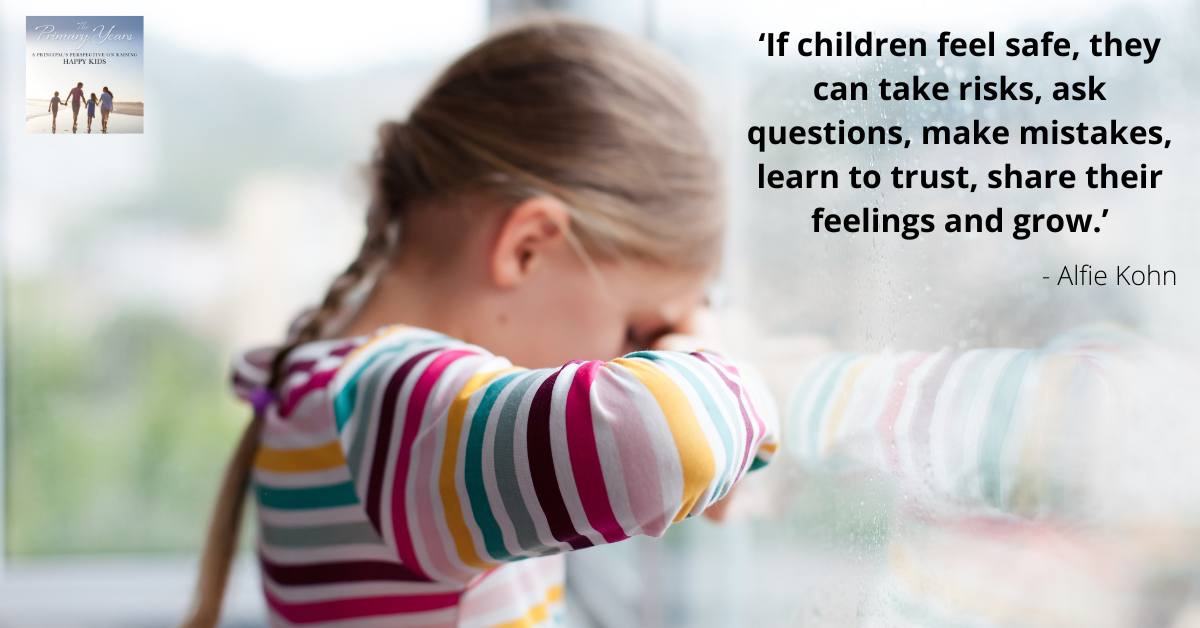
‘If children feel safe, they can take risks, ask questions, make mistakes, learn to trust, share their feelings and grow.’
- Alfie Kohn

The importance of simply reflecting on what a child has to say
Children can come out with all sorts of negative comments, but tt is all about really listening to the child and picking up what is the real bottom line of the problem, especially the feelings. It's important to reflect on what a child has to say and really listen.
This is all about reflecting back to the child what the child has said to you, the parent. It is all about paraphrasing what has been said, picking out the most important content details of what has been said by the child. The parent then talks back to the child expressing what the child has said and giving reassurance to the child that they actually heard the essence of what they were saying. The parent can pick up on the emotional aspects to the child’s conversation.
Child: ‘I hate it when my friend won’t play with me.’
Parent: ‘You are upset if they do not play with you and you feel hurt.’
It is all about really listening to the child and picking up what is the real bottom line of the problem, especially the feelings.

Reflecting on what a child says is not:
Using the information to lecture the child.
Correcting the child’s information.
Expressing an opinion on what the child says.
It is actually:
Listening without questioning the content.
Holding off on having opinions on what they say.
Being neutral and getting to the essence of their hurt.
Simply listening and not interrupting.
It is about respecting their pain.
Keep in your mind some feeling words that come in handy when reflecting back how your child felt. Words such as;
Happy, sad, angry confused, disappointed, surprised frightened helpless, insecure.
For example: ‘You seem unhappy that your friend left the school.’
Reflection of feelings is used extensively in counselling situations but it is also a very useful tool for a parent to let their child know that they heard their pain.
‘The way we talk to our children becomes their inner voice.’
Peggy O’ Mara

Set small goals to set success.
It is well known that success breeds success and the more a child feels capable and experiences success they quickly build their confidence which feeds into more success. A child’s daily experiences can help build confidence and encourage further achievement if they are more likely to try new things.
Encourage your child to develop successful habits. It is well known that success breeds success and the more a child feels capable and experiences success they quickly build their confidence which feeds into more success.

Teachers know that when a child gains a sense of success and achievement they are generally happier and more inclined to take a risk and to not worry when they make a mistake. Once they feel capable of success and have demonstrated it to themselves, taking risks is a comfortable process and they’re not worried about making mistakes as their emotional stamina is strong enough to deal with failure.
Attract success. A child should have regular incidences of success both at home and at school. They can be intermittent but they come as part of the child’s daily experiences. Remember ongoing success continues to feed into that sense of well being.
Do you notice how often in small ways your child is successful and if so do you acknowledge it? For example, when your child learns to skip, do headstands, write sentences correctly, play fairly and well in a sports team etc. these are successful occasions. There are many occasions to show how they are successful. These are small incremental steps but build a body of success.
Tell your child that they have had a success when you notice it and talk about the positive feeling associated:
‘You must be so pleased with yourself that you can now get your pen license from school. Well done. What a success.’
A wise person looks to achieve goals that are within grasp. It is all about not sabotaging your sense of possible success. It is about being realistic. You can help your child choose goals that are within reason. Certainly no harm in stretching their thinking but take care that they are not setting unrealistic expectations doomed for failure.
A child who goes after smaller and more regular goals begins to feel very confident and will wisely choose goals that take them a step ahead.
Think about how a child learns to walk. Through trial and error they learn and gradually they push themselves a little harder. What joy for them and everyone when they finally walk. Something drives them to keep going as they move from crawling to sitting up, etc.
Working towards a goal should be a happy experience and should not come with too much stress and anxiety. Too much pressure on a child will make the goal too unreachable and unjustifiably a child will feel a failure. Small steady chunks to achieve reasonable goals is the best way forward.
Teach your child that celebrating success is important along the way. Make it a family habit to regularly talk about the small successes that your child makes. Be noisy about it and it will appear an expected and natural part of life.
Setting a goal that is a long way away means that you need to help your child take small steps to get there. For example, their goal is to learn how to sew and they want to make a dress. You will take small steps in teaching them and applaud the small improvements along the way. So much to learn but with increased knowledge and experience on the sewing machine the final garment is a product of great pride and success.
Finally, be observant and notice those small, incidental, successful steps your child takes and they will do the rest!
‘Success is not final, failure is not fatal:
It is the courage to continue that counts.’
-Winston Churchill

Is your child comparing themselves to others?
A child is always on the go developing their sense of self-worth and building foundations that reassure them of their worthiness. They don't need to focus on others around them who are doing better or who perceive to be more successful. Read here for some suggestions to help you work with your child in offsetting unfortunate comparisons and how to build their self-esteem.
When we start to compare ourselves unfavourably with others it becomes obvious that we are lacking in self-confidence. Comparing ourselves to others can be all about how we look, how happier others are or perhaps how more successful people are around us. We notice the differences and we become unhappy or dissatisfied with ourselves.
A child is always on the go developing their sense of self-worth and building foundations that reassure them of their worthiness. They do not need to focus on others around them who are doing better or who perceive to be more successful. Finding the grass greener on someone else’s turf or forgetting about your own strengths is a forerunner to ongoing doubt and failure. There is simply nothing going for judging yourself against others.
Such negativism also destroys your beauty within and others see the bitterness and stagnation that can creep into your life. It can be given the name, resentment.
There are many influences that can cause us to compare with others.
Advertising invites us to compare and buy the best. Social media is all about creating perfect images that we would all like to be. Consider all the growing businesses for plastic surgery that will change the way we look and create someone else’s image that would make us feel better!
Body image is a massive area for children in which to take control. We think about how fat or slim we are compared to what society thinks is beautiful. We tend to relate body image to self-esteem. For a child this can be a concern as they become quite anxious about what others think about them. Unfortunately, as the child grows they see that many people judge others by what they wear, what they say and how they portray an image. To fit into a child’s social world, they may think they need to change to feel good about themselves. We know this as group pressure.
We need to teach our children to love their own body, no matter what shape, size or colour it comes in. It is their business and they need to be happy with themselves. We reinforce these concepts by demonstrating ourselves how we treat our body and how we see beauty in many forms and not the prescribed view of beauty through social media etc. If we want change we introduce change driven by our own desires and not controlled by media hype. This is such an important message to give our children.
Here are some suggestions to help you work with your child in offsetting unfortunate comparisons.
Encourage your child to think of others and applaud their efforts. Be the person who affirms others successes and talks about their achievements. It is a mature and sometimes brave act to celebrate other people’s achievements as it demonstrates that you care about others. It is also a mature chance to learn from them. What can you take from their success story that will be helpful to you?
Remember to teach your child to be self-encouraging. They need to learn that they can be great motivators for themselves. Talk about some great self-motivators such as Ash Barty whose self-discipline comes from her self talk which is so positive. Also, teach your child to think about what they are good at. Get them to write it down and talk about it quite often as a family. Naming the good stuff is so valuable and seeing it written is more inspirational.
Often people that look confident are confident. Once people see you being more sure of yourself they pay more attention to you. Once a child sees that others see them as confident it tends to feed off itself.
Take care that we avoid negative self-talk when something goes wrong. It is easy to self-blame and call yourself dumb or stupid. When your self-talk is positive you are giving yourself permission to be successful and it works!
We need to teach our children to simply be the best they can be and this will be and should be enough. You applaud their effort to improve but above all their expectations are enough. Often we become anxious about what we are not, rather than having confidence in who we are and what we have to offer. We need to value what we have to offer. Reinforce with your child how happy you are simply with them and you would expect nothing else.
Tell them: I love your uniqueness.
“I appreciate your generosity.”
“I can see your thoughtfulness.”
Name and claim these individual traits in a loud voice that make your child the very best.
Finally, it is not an easy task helping your child overcome the temptation to compare but nonetheless you are instrumental in creating and building a very positive self-image of your child that acts as a strong foundational tool in building self-worth and positive well-being into their future.
‘Why are you trying so hard to fit in when you’re born to stand out.’
-Oliver James


Learn to complete things - an important lesson for our children
Not completing things is a form of self sabotage where you may get bored easily and literally stop short of being successful. It can be very habit forming and a way of dealing with things that just seem too hard. Sound familiar? We are all guilty of it, but we can play a role in teaching children how to follow through and make decisions to commit and see something through.
Not completing things is a form of self sabotage where you may get bored easily and literally stop short of being successful. It can be very habit forming and a way of dealing with things that just seem too hard. It also means that you leave many loose ends that can make you feel quite unsatisfied. Giving up before reaching the finishing line is a sure way to defeat confidence and it repeats itself. Starting projects can seem exciting at the beginning, but ploughing through the hard stuff, often leads people to quickly give up. Now consider your child. How much easier is it for them to give up when it just seems too hard.

It’s important to teach our children to finish what they start.
Consider:
If your child gets excited at the prospect off joining a sports team, tennis lessons, swimming club etc be prepared to talk through the length of the commitment as often children struggle to understand that there is a time frame that you must adhere to and honour your commitments.
Help your child with managing the commitment as there is often a waving off time when a child wants to pull out after the initial commencement of the program. Keep on talking to them about the positive outcome of completing and try to explore how obstacles can be removed from the path of completing the task.
Ensure that you do not have too many commitments on the go with your child. This makes it easier for them to pull out because of excessive demand. Smaller goals and less of them is more likely to be successfully completed.
Affirm your child when they demonstrate that they show commitment to some project. Applaud the endurance and effort and especially the celebration of completion. Teachers often issue certificates of completion as they understand this has merit to a child who will feel good about themselves seeing the certificate.
Being a completer of things shows that you are developing self discipline so demonstrate to your child how famous people with strong self discipline succeed. I immediately think of Ash Barty who has been a wonderful model to young Australians. Her recent retirement from her successful tennis career was all about completing her goal of winning the Australian Open. Once done, she now moves on to other goals.
Talk to your child of positive reasons for finishing tasks. This can be starting with small tasks. The more a child builds success from completion, the more perseverance they develop in keeping up with finishing projects.
Children will easily give up a task if they think it is not good enough. This starts from an early age where a child will walk away from a drawing, painting etc. Here we start the habit of teaching them that completing the work makes for success and it is all about having a go and completing the activity. Often a parent could give a young child a small reward for, demonstrating that they finished what they started. This is all about good conditioning from an early age, establishing patterns that are set for life.
Finally, nobody wants to stifle the enthusiasm of a child when they discover some passion or interest in a project they they would like to start. However, we do need to gently outline the lengths and parameters of what they are taking on to avoid disappointment and a sense of failure when incomplete. Perhaps we can find supportive ways to help them complete tasks and of course to affirm their ability to demonstrate completion. Nothing more satisfying then to complete tasks and I guess this is what we would like our children to feel.

Strengthening a child’s interest and endurance with reading
It can be a fine line between pushing the child to read and gently setting the scene to help them. Reading is vital in a child’s development and learning. Here’s some tips to encourage reading at home.
This can be a tricky area if you have a child who is reticent to read. In my experience, I have seen this behaviour more in boys than girls and therefore a parent must connect to a child’s interest in reading to help them become more of a motivated reader. It can be a fine line between pushing the child to read and gently setting the scene to help them.
Consider;

Generally, children will not read without some purpose in mind. As a parent talk about what they are reading and why they may be enjoying it. Never question or make a judgement on whether it is a magazine, novel, cartoon series etc. you are just talking about what makes them want to read it.
The family can play a big part in encouraging reading. Some families read a novel after dinner together. Some ask older siblings to read to younger ones. Some children look forward to bed reading with a parent. There are many shades of a family reading together and as long as reading is seen as an important icon and is a regular part of the week, the message is clear. Reading is here to stay.
With younger children reading aloud is valuable and children enjoy the family experience of reading and sharing the story together. Repeating the same books over and over again is very acceptable as it shows how enriching the story is and the heightened level of enjoyment. Sometimes young prereaders enjoy reciting the words of the story which is a great precursor to reading.
Talk to your child about where in the house is the best and most comfortable place to read. Keep the area away from distractions such as television and if the child likes to read in their bedroom until they are active highly engaged readers they can find many distractions in such a space. The environment must be conducive for reading with comfort.
Some families use dinner time to talk about the book they are readings. Talking about books keeps the interest alive in the home.
Don’t be perturbed by what the child chooses to read. They need to explore different reading material before they really discover what interests them.
Boys need encouragement and will often choose books that are cartoon based, or more inclined to be fact-driven. All of this is acceptable. The important point is to keep your boy engaged in the act of reading. Take care not to force books on them as this can cause a block to reading. Consider audio books as an option.
Don’t forget the importance of you, being a critical model. The more you demonstrate a love for reading you are giving your child a clear message that reading enriches your life and it is a force of great joy.
Ensure easy access to books. Perhaps regular trips to the library or simply leaving easy reads around the house. Consider downloading free e books for your child.
The child should feel happy and willing to choose the book. They will have more success with reading if they own what they read. The reluctant reader still has interests and maybe passions in different areas. This is where you can talk about their interests and bring home books that talk about their passions. Often this can stimulate a child to look into a book that might satisfy their thirst for knowledge. A reluctant reader can be tempted by books that give them important information that accommodates their interests.
It was common practice in classrooms to have a dedicated thirty minutes to silent reading often after lunch. Children looked forward to this time which was mandated across the year and understood as an important part of a child’s learning across the week. Is something like this possible in your home?
People will read for different purposes and this is always acceptable and the more likely reason for reading. Children will over time, gravitate to what they really enjoy in reading. Some love reading for pleasure, others read for information gathering and instructions. We all gain different outcomes from our reading experiences but while we are learning the art of reading we need to feel embraced by various options to read and to feel that we are enjoying the process.
Everyone is entitled to be literate and to have access to information to help them through life. Reading, acquired early in life and in a climate of trust builds our confidence and provides necessary skills invaluable for life.
‘To learn to red is to light a fire; every syllable that is spelled out is a spark.’
-Victor Hugo

Developing the two halves of our brain.
Read here for tips to help develop both sides of your child’s brain.
Both sides need good interconnection to think well.
If your child is actively engaged in sports that is a wonderful beginning to balancing both sides of the brain. We are born with this amazing computer but as a muscle we need to give it considerable exercise. Neuroscientists have found that the two sides of the brain are engaged at the same time. Left brain people focus on logical and clear thinking. They are drawn to order and structure being analytical and focusing on accuracy. If your child is right brain focused, it is more about creativity, emotions and aesthetics, intuition and thoughtfulness. They are your sensitive children.
Think about your child for a moment. Can you see some aptitude in other direction? The trick is to balance both sides giving the individual a chance to develop greater potential in their thinking and processing.
It is natural to drift back to what you are most comfortable with and this can easily happen when a child does a project, writes stories, plays games etc. A child who loves order and takes pride in having everything clearly laid out, can sometimes become anxious when taking risks. Often they don’t like failure and become anxious when they are not prepared.

On the other hand, children who are very creative can be far too sensitive and not cope with criticism and become quite unsettled when people challenge them. In reality, we can probably see both elements in our child from time to time, but nonetheless, it is worthwhile encouraging your child to work on balance.
Consider:
Try to practice reading at different speeds and putting emphasis on different words to create different feelings about the story.
Play ball games where children use both hands for catching or change the rules to encourage different ways to think through the game.
When a child creatively writes a story invite them to itemise the main concepts.
Involve your child in learning a craft that requires change and pattern building. Activities such as knitting, sewing, sculpture etc. are wonderful for learning order and design. Simply reading a pattern requires thinking on a deeper level.
I know how creative Lego is but it could be used to think through different ways to be creative and not just building structures. Challenging the thinking in this area really gets the brain working.
Cooking and improving recipes is another great way of challenging the thinking process.
It can be as simple as having a conversation about how the practice went and then ask your child to suggest strategies that would improve the game.
Leave lists of tasks to be done on the fridge. They are to be marked off when done. Sometimes vary the lists and invite your child to draw up their own or rewrite amended lists.
When visiting good games shops you will find quite a variety of games that challenge the child to be creative and at the same time think logically. Spend some time perusing these games as they can be great family fun and really stretch the thinking in different ways.
Highly sensitive children can be more emotional. You may need to spend more time with them conditioning them to think about positive thoughts when they become overwhelmed by issues. They will need to learn strategies to help them overcome sensitive feelings.
Teachers know to change the look of the classroom around to stimulate different thinking and to challenge the children with questioning and memory.
These exercises are illustrations of developing a balance and recognising that at times you need to refocus your child when the emphasis lies too heavily on one side of the brain. The more children exercise their thinking in various ways the greater capacity they have to learn and accept challenges that come their way.
‘When you want new results, it requires new thinking.’ -Richard Brandler

Children who find school a struggle
Many children have times when they feel they are struggling not just with school but also with friends, home issues, siblings, etc. Children can and do have down times. If your child is struggling, read here for some tips.
Many children have times when they feel they are struggling not just with school but also with friends, home issues, siblings, etc. Children can and do have down times. It’s natural. Also there are some children who really find the process of school difficult academically and socially. There are many shades in between but it is reasonable to say that most children will have some struggles along the way. A proportion of this is acceptable, but when it gets out of hand it is necessary to intervene but effectively.
Consider:

If your child has outbursts of frustration then these must just happen. Sometimes frustration comes out through poor behaviour, moodiness, etc., but these feelings need to be expelled. It is their way of letting you know how poor they feel and they want you to have that same feeling. Best to let it happen and gently talk to them:
‘Seems like you have something on your mind. You are so upset.’
Here you are giving them a chance to simply talk about the matter. You are not asking the question, why?
Creating space when tension builds is a great vehicle for a child letting off steam and it gives you the parent a chance to process what has just happened with the outburst. Many a time in the classroom, when tension was building up, we all went out for a quick run on the oval. It was an amazing way to break from the stress and it set the scene for a new direction. Fresh air and a quick walk can make all the difference for all parties concerned.
After a child becomes reactive you cannot go straight into conversations, trying to make sense of what has happened. They are simply not listening at that point and probably will not hear the logic of what you are saying. In our best interest we want to understand the behaviour but think about yourself after you have been quite upset, do you hear what people are saying to you? The same happens after shocks. That immediate follow up time is a time when listening is non existent.
There is a tendency to naturally help our children excessively especially when we see them struggling. Whilst your assistance is needed and valued it, should be tempered with the child learning about failure and accepting that we learn through failure. However, a child must have feelings of success along the way. So I appreciate the care and balance you make as a caring parent when helping your child.
Keep the school close to you. They are the key figures in formal learning for the child. They set homework and should take responsibility if it is too much for the child. Homework is very secondary as a learning tool and should not come between you and the child. Remember you are not the arbitrator of what the child learns. You are the loving parent giving reassurance.
Helping your child put organisation into their life is a great way of supporting their learning. Many children can get overwhelmed by the school’s expectations and if you gently assist in helping them plan out the week this can reduce pressure.
If you have a child inclined to build anxiety quickly then consider slowing down the expectations for the week. Tailor those expectations to suit how the child is coping and be flexible when it comes to domestic expectations etc. A change in pace can make all the difference for an anxious child who lacks confidence.
Plenty of sleep and exercise is a critical dimension to a child’s life. Sometimes when a child is struggling at school they may have success through sport and they feel so much better.
Try not to keep asking how are they going at school? They will tell you in due time. Asking too often can only encourage them to shut down and not talk about school at all. After all who wants to talk about feeling a failure? Turn your questions about school into a positive framework:
‘You seemed happy coming out of the classroom, I wonder what that was about?’
Classroom teachers are very conscious of providing daily balance for the children throughout the whole week. This balance is all about ensuring they have successes and they learn from mistakes. They should have moments of feeling good about their achievements and moments of being socially well accepted. It’s all about the right checks and balances and so too is our parenting, especially with those children more vulnerable.
‘There are two gifts we should give our children, is roots and the other is wings.’

Perfectionism...to be discouraged in our children
A child who is a perfectionist does not feel free to make any mistakes and we know that mistakes are an important form of learning for your child. If the child feels too anxious to make mistakes their confidence drops and all sorts of behavioural complications can enter the scenario. Read here to navigate the world of perfection in your child.

This can be a problem for some children who really struggle to accept anything less than perfect. How frustrating this can be for them as they never seem to be at peace unless they are correct 100% of the time. For themselves, they set very high standards. They also see that other people value them for how much they have achieved rather than for who they are. These are unsafe values upon which to be basing your sense of self. A child who is a perfectionist does not feel free to make any mistakes and we know that mistakes are an important form of learning for your child. If the child feels too anxious to make mistakes their confidence drops and all sorts of behavioural complications can enter the scenario. There is no joy in working from perfectionism and it can be seen as early as young children not writing a sentence for fear they make mistakes.
Teachers are very astute when they find students reticent to have a go or reluctant to put themselves forward. They realise the more they allow the child to step back and make no attempt, the more poor conditioning steps in and the harder it is to get them back in the groove of doing activities.
At home there are ways to help the child begin to overcome this problem.
Consider:
Firstly and most importantly consider if you are a perfectionist. You can have a major influence on your child if they see you operating as a perfectionist.
Show your child how you work through problems. Let them see that making a mistake is a way of learning.
When they show you their work, affirm its worth. Remember it is the effort you are affirming and not the quality of the work as a final product. This habit should start with very young children to be successful.
For these children, competition is important but within reason. Very young children are often keen to show you what they have done be it a drawing, sand sculpture etc. This is a tender age for building the understanding that you are impressed with all their attempts.
Keep installing the value of ‘have a go’ and telling your child that through trial and effort learning occurs happily.
With older children, it is worth talking about some great successes such as Einstein who based his life on learning from taking risks and mistakes.
Use practical examples in your own life when things went wrong and still you learnt.
Wherever possible take away the pressure to succeed. That may mean talking to your child’s teacher about potential problems that could stem in the classroom. It could mean putting your child in situations where there is not an obsessive focus on success. Healthy competition is important but some environments may be not suitable for your child who becomes fixated on being perfect.
When a challenge comes your child’s way, we do not talk about meeting that challenge for fear of failing. We meet it to simply have a go and improve in some capacity.
‘Have go at swimming backstroke. You will learn so much from just making an attempt.’
‘Well done you made a great effort and for the first time swam a little on your back.’
Here it is about picking up on the effort and noticing a difference. There is no focus on being perfect.
Children who have a tendency to be perfect often prefer to stay in their comfort zones. This give them assurance and they don’t need to try as they may fail. Give your child various opportunities to try different things. Take them out of their comfort zones and challenge them to do different things. This could be through sports,family holidays etc.
Sometimes children feel under pressure when the issue of success comes up. For example, school tests,sports event, social event etc. Preparing the child before the event is helpful by reminding them of the time they had a go and it worked out. Also reinforcing how you award the effort not so much the outcome.
Try to avoid being an overprotective parent. Such a model limits the child’s opportunities to take risks and discover their own potential.
Finally, as a parent whose child has perfectionist tendencies try to be more relaxed and let your child see how the value in life is about not fearing the unknown and learning to embrace some risk and challenge. Let them gradually feel the joy of simply exposing themselves to change and feeling success from the experience.
‘Focus on progress not perfection’
-Bill Philips

A helpful child is a useful thing. I guess?
The home should be a place of rest, safety and feeling secure in a child’s own skin. Of course duties around the house are important but should not overwhelm the child nor should they become a battleground with parents. I stress this as I have seen many unsettled children grow unhappy due to demands at home. Read here for considerations when setting chores at home.
There has been some recent research released from Latrobe University stating that children that do jobs at home develop into more rounded individuals capable of taking on responsibility and managing themselves well. That sounds wonderful and why not engage your child with home duties? There is quite a lot to learn for a child taking responsibilities in the home not the least of which is that they occupy the home space and should take some ownership.
This article is to invite us to find the balance of a child having home duties and to take into consideration all the other responsibilities and pressures that are on a child. When working with children myself a significant factor in supporting them was to help them overcome their sense of being overwhelmed by all the social pressures and other demands in life.
The home should be a place of rest, safety and feeling secure in a child’s own skin. Of course duties around the house are important but should not overwhelm the child nor should they become a battleground with parents. I stress this as I have seen many unsettled children grow unhappy due to demands at home.
Consider:

Plan jobs together as a family and check in regularly as to how they are going. Gives lots of affirmation when a job is done well.
A regular family meeting should not become a tense bun fight because jobs are not done well. At these meetings negotiate with your child around suitable tasks that are fair and reasonable. Understand that a child’s expectations may be different.
If your child has a busy week at school or extra demands on them in some other way, consider modifying your expectations around the house. We all need respite from tasks from time to time.
A child is more willing to do tasks if they see the value in them. Tidying their room is often not a value they care about and can often become a sore spot with parents. Talk to your child about what they see is important around the house and relegate those tasks to them.
Try to not discuss tasks that are not done in front of other people. Try to create an environment at home that is inviting and happy for the child. Discuss with them your concerns in private with an attitude to listen well to your child.
As the child grows older the tasks will change and always keep in mind that a child is less interested in spending time with the dishes then being outside with their friends. Therefore, encouraging them to support you must be handled carefully.
‘Let’s do the dishes quickly so that you have more time to play with your friend.’
Here you recognise what is important to them and you use encouraging ways to help them. Showing this support goes a long way with the child who sees that you still expect the job done but understands what is the real driver for your child. You have no expectation that they should love doing the dishes.
As the child grows into a teenager there are of course more expectations to be placed on them but remember that for a teenager to enjoy home it should be filled with happiness and understanding as it is too easy to escape the scene. Jobs should be allocated fairly and in consideration of the teenager’s changing expectations. Who knows any teenager that likes home jobs!!
Finally, a supportive word for the child. We all only have one chance to have a great childhood and this should be filled later with memories of happy experiences and a home that is not punitive but just and loving. It should be an environment where the child takes adequate responsibility in a space that invites negotiation, is open to change and willingly listens to concerns.
Long may home duties exist for a child but finely balanced so as to not stifle the joy of childhood.
‘A home should be a stockade, a refuge from the flaming arrows of anxiety, tension and worry.’
-Wilfred Peterson

The words we choose to use.
How we speak to our children is long-lasting. Read here for some thoughts on how to manage ourselves in using effective communication with children.
When you think about your impact on the world and most specially your children, consider that what you say delivers important messages and sends out clear vibes to all within earshot.
According to a very early philosopher, Horace 65-8BC
“words once spoken can never be revoked”
Sounds harsh and yes, we all make mistakes in how and what we say from time to time, but the impact can be great and the words lasting, if hurtful. Children are particularly sensitised to the words we use when we talk to them. Careless speech can have a longer-term memory with children. Name calling is taken to heart and can come under the banner of emotional bullying.
Teachers know all so well that the words they use around children will have an impact on teaching them. They realise very early in their career that their use of language can make or break a child’s interest in learning.
Here are some thoughts on how to manage ourselves in using effective speak around our children.
It is often said to have your mind well ahead of your mouth. By reflecting on what we are about to say, we can choose our words carefully, which do no harm, but deliver a good message. Some say stop and think before speaking. A small moment of thought can also slow down any quick temper we may have, which can influence how and what we say.
Watch the tiredness. When we are feeling tired, we are less likely to speak well, but rather more focussed on just getting the message across. Consider if you are tired is it necessary to have an in-depth conversation with your child? Sometimes it is best to wait. Silence can be very effective at times. It allows some mental breathing space.
Using words well can do an amazing amount of good with our children. They often hang on our words and listen carefully for the intent. The more we speak affectionately using a positive tone of voice, they feel reassured and valued. Never fall into the trap of thinking a louder, sterner voice has more impact. It in fact shuts people down from listening. Minds close in an effort to protect themselves from bombarding sounds.
Our children live in a world where less speak and more action on social media which is isolating is seen as better. Therefore, sound, healthy discussions using positive language and reassuring words is important to counterman the shrinking oral language used around our children.
To build a strong relationship which your child you will need to be using language to get messages across, reassure them and nurture them. There is nothing more delightful than hearing words used by a parent that are positive, reassuring, loving and wholesome.
This is about using words wisely and understanding the power of them to build relationships. Careless, thoughtless words are hurtful and damaging. They serve no positive purpose in strengthening relationships.
Of course, we can say sorry for careless words used and ask for forgiveness. The challenge is to train ourselves to avoid such language and if necessary, say nothing. Less careless words used presents a very reassuring image as a parent.
An old saying is: if you can’t say anything nice then don’t say anything at all. What a fine message this is to finish the blog!
‘Choose your words wisely. They reveal your inner character.
-Jim George